BASIE
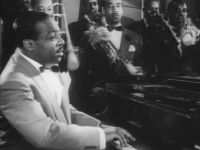
William "Count" Basie (August 21, 1904 April 26, 1984) was a pianist, organist, conductor and especially jazz. It was soon recognized as one of the greatest leaders of Big Band orchestra of his time. He created an orchestra, the Count Basie Orchestra, renowned not only for music but also for the artists featured as Lester Young, Herschel Evans, Buck Clayton, Harry "Sweets" Edison, Jimmy Rushing and Joe Williams had grown up under the direction of Basie. William Basie began his piano lessons with his mother at a young age despite the fact that he is more interested in percussion. Growing up, the young Basie was attracted by the music of Ragtime produced by the great pianists in Harlem, he was also teaching in Fats Waller organ. His debut was made, it seems, is in the circuit T. O. B. A (Theater Owners Booking Association) playing for vaudevilles, either by taking the place of Waller at the piano piece for Katie Crippen and Her Kids. He ended up playing for other comedies of Gonzelle as White and the Big Jazz Jamboree. C was on tour with the play The White Gozelle that Basie met the group of Oklahoma known as The Blue Devils. After having had the opportunity to hear them play, he was inspired and he befriended the lead singer, the legendary blues singer Jimmy Rushing. Basie had the chance to play with the "Blue Devils" during his stay in Kansas City, before having to return to his vaudeville. However, luckily, the play The White Gozelle should be divided, leaving Basie, unfortunately sick, Kansas. He remained in hospital for some time, then he took a position as organist for a film called Eblon Q Where were screened silent films. In 1928, bassist Walter Page invited Basie to join the Blue Devils, Basie accept an offer. C was around this time that he became known as Count Basie. He toured with the Devils before returning to Kansas City and Eblon to resume his career as organist. In Kansas City, he heard about the new group of Bennie Moten and decided to find a way to participate. After that he was part of the group of musicians, he took charge of the arrangement and composition of several songs, moreover, it often took the place of Bennie the piano for a show. Basie Moten remained in service, until the death of the latter in 1933. The group wanted to stay together, but alas, this is not well spent. However, with some members of the group and some new people like Lester Young on tenor saxophone, creates the new Basie band explosive to be known as The Count Basie and His Barons of Rhythm. The group was known for his flawless rhythm and to give voice to two tenor saxophones, making Basie the first to write for two tenor saxophones. Basie's group will grow and will be heard on the radio station of the city of Kansas City. Their popularity will point by John Hammond, a radio star in New York, which will take them to New York in 1937 for their first sound recording. During the '40s, his group has been internationally recognized, even if the war takes place, which caused some financial problems. With the exception of 50 years, where Basie did some touring with a quintet, he continued to be band leader for his group until 1970. During all this time, Basie had commercial success with each sound recording that he delivered to the public. However, the mid-70s, his health began to deteriorate. In 1976 he suffered a heart attack, finally, in 1984, cancer ended the life of the great William Count Basie, then at age 79. The music seemed to flow on its own: a lot of blues and simple themes based riffs, driven by a superb rhythm section as the softest and developed by outstanding soloists. The practice of "head arrangements", unwritten arrangements derived from the complicity between musicians, adds to the spontaneity of the music. Arrangements are built to raise tension while telling a story with its beginning, its development and its conclusion. The solos fit into this orchestra enriching orchestral motifs and often creating an effect of suspense. Basie also introduces the "chase" (duel) between soloists including tenor saxophonists between its two opposite styles, Herschel Evans and Lester Young. The latter, for his distinctive style, particularly enriches the musical discourse of the orchestra and several titles are built for the showcase as "Roseland Shuffle" or "Every Tub". From the 40s, the overall game becomes more complex and takes a growing place face soloists. His second full orchestra, from the fifties, made from finest of arrangements (especially those of Neal Hefti, Ernie Wilkins and Sammy Nestico) served by a perfect unity of all and a great sense of dynamics but slightly more agreed. The piano, the economy of notes was the brand of laconic style of Basie, the intense rhythmic power. One O'Clock Jump and Jumpin 'at the Woodside are his best known pieces. Open the Door, Richard was 1 of the U.S. charts in February 1947 [1]. Henri Salvador borrowed music from Lil 'Darlin' for his song called Count Basie. Google machine translation: BASIE's original bio |