
Francis POULENC
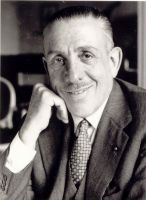
Francis Poulenc, born January 7, 1899 in Paris, died January 30, 1963 in Paris, is a French composer and pianist, member of the Group of Six. His father was a founder of institutions Poulenc Brothers, which became Rhone-Poulenc. Although he took some lessons in composition with Charles Koechlin, Poulenc is considered a self-taught composer. After schooling at the Lycee Condorcet, he knows eighteen first success with a negro Rhapsody. With World War I, its production is not important. It consists, however, The Bestiary, a song cycle. Ricardo Viñes him meet particular Isaac Albéniz, Claude Debussy and Maurice Ravel. Poulenc is one, with Georges Auric, Louis Durey, Arthur Honegger, Darius Milhaud and Germaine Tailleferre informal group of musicians that the critic Henri Collet in 1920 nicknamed the Group of Six, referring to the Russian Group of Five (Mussorgsky, Cui, Balakirev , Borodin, Rimsky-Korsakov). Their common aesthetic, influenced by Satie and Cocteau, is a reaction against romanticism and Wagnerism, and also, to some extent, against the Impressionist. The group of six has created only two collective works: a collection for piano Album of Six, and a ballet, The Married to the Eiffel Tower. In 1926, he met baritone Pierre Bernac, for which he had an emotional attachment, and composed for him a large number of melodies. He accompanies on the piano, from 1935 (and until his death in 1963), in French musical recitals given around the world. Pierre Bernac is considered the muse of Poulenc for the unearthing of many melodies of Poulenc. In 1928, the composer wrote The Pastoral Concert, CARRYING for harpsichord and orchestra for the great harpsichordist Wanda Landowska and dedicated to his companion, the painter Richard Chanelaire. In 1935, passage of Rocamadour and following the accidental death of his friend, the composer and critic Pierre-Octave Ferroud, he saw a radical return to the Catholic faith of his childhood and turns to faith-based compositions. After this event his piano works are much rarer and are imbued with a deep melancholy. In 1936 he composed his Litanies to the Black Virgin of Rocamadour, for female choir and organ (he later orchestrated), followed in 1937 of the Mass in G Major for ur hp mixed a cappella, a Stabat Mater ( 1950) and a Gloria (1959). The composer also wrote his famous Dialogues of the Carmelites in 1957. Critic Claude Rostand, in recognition of the coexistence or alternation Poulenc of great gravity and the Catholic faith with recklessness and fantasy, coined the famous phrase "rogue or monk". Thus, about his Gloria, which caused quite a stir, the composer himself declared: "J have thought, simply, the writing in these frescoes of Gozzoli (Benozzo Gozzoli) where the angels stick out their tongues, and also these serious Benedictines whom I saw one day play football ". He left several recordings as a solo pianist and accompanist. There's also some recordings supervised by him and performed by artists he favored in his lifetime, as the baritone Pierre Bernac, soprano Denise Duval or the conductor Georges Pretre. He is buried at Père-Lachaise in Paris. Google machine translation: Francis POULENC's original bio |
 |
| ||
| Francis POULENC Arr : Egbert VAN GRONINGEN Publisher : Baton Music Genre : Orchestra Group : Wind band |
Set Wind Band (BM184-BA) : € 179,88 Conductor (BM184-CO) : € 44,97 |
||